
Before You Choose A Surgeon
Please check with your local health authorities.
Note: Each country has its own laws and regulations on what a doctor and a technician should do.
Questions You Should Ask
There’s no such thing as a dumb question…
Before you make a final commitment for hair restoration surgery, it’s a good idea to ask your hair restoration surgeon a lot of questions so you can have confidence in your decision.
- How do I choose a hair restoration surgeon?
- Who will evaluate my hair loss and recommend a course of treatment?
- Who will be involved in performing my surgery?
- What is their education, training and experience in treating hair loss?
- Are they licensed?
- What should I look for when selecting the right surgeon for me?
- How do I know the people performing surgery are qualified?
What Should a Doctor Do in Hair Transplant Surgery
When doing research for hair transplantation, make sure that you ask important questions including, “Will a surgeon be performing my hair transplant?”
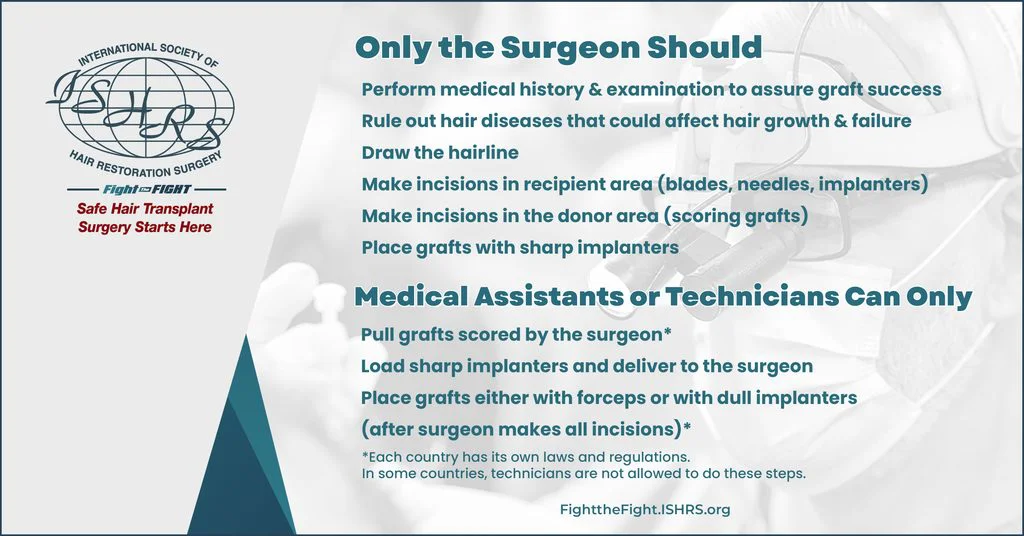
With so many unlicensed technicians performing hair transplant surgery in illegal clinics, and in many cases without a doctor present, it is important to know what the doctor should be doing and what a technician can do.
Only the Surgeon Should:
- Perform medical history & examination to assure graft success
- Rule out hair diseases that could affect hair growth & failure
- Draw the hairline
- Make incision in the recipient area
- Make incision in the donor area
- Place grafts with sharp implanters
What Can a Technician Do in Hair Transplant Surgery
Technicians Can Only:
- Pull grafts scored by the surgeon*
- Load implanters and deliver to the surgeon
- Place grafts either with forceps or with dull implanters (after surgeon makes all incisions)*
*Each country has its own laws and regulations. In some countries, technicians are not allowed to do these steps.
Training and Credentials
No doubt you are doing your homework to choose a highly-regarded and credentialed surgeon – he/she should be the one doing your surgery.
Questions about the physician’s training include:
- From what medical school did the physician receive his/her M.D., D.O. or M.B.B.S. degree?
- What year did he/she receive the medical degree?
- When was the physician licensed to practice medicine?
- Where did the physician complete internship and residency training?
- Did the physician have additional training in a medical or surgical specialty?
- Is the physician board certified or a diplomate of a legitimate certifying board?
- Does the physician hold membership in their related specialty professional society?
What is Difference Between FUT (Strip) and FUE?
Comparison between Strip Harvesting and FUE: Part 1
Comparison between Strip Harvesting and FUE: Part 2
Comparison between Strip Harvesting and FUE: Part 3
It is important to know that both FUT (strip) and FUE results in scars. There is no such thing as “scarless” surgery in hair transplantation.
The ISHRS is concerned about false and exaggerated advertising claims related to hair restoration surgery such as “scarless surgery” or the claim that the surgery can be completely performed by a machine.
Frequently Asked Questions
- How long will my procedure last?
- Will people notice my hair transplantation?
- How much will it cost?
- Will it be painful?
For more resources please visit ISHRS Consumer Advocacy page here.